Blogia

EnglishWorld

DICTATIONS SECOND SENIORS (13,14,15)
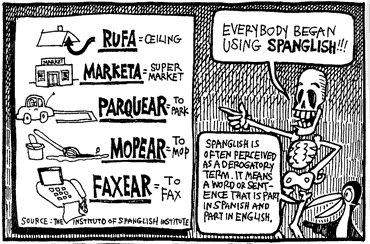


Spanglish


         During the nineteenth and early twentieth centuries, millions of Europeans and Latin Americans went to live in the USA. Within a couple of generations, most of the French, German, Italian and Russian immigrants spoke only English, but many of the Spanish speakers became bilingual.


         Today there are about thirty million Hispanics in the USA who speak Spanish and English. Often the Spanish they speak is Spanglish, which is Spanish, but contains many words of English origin. Some examples of CyberSpanish are maus and chatear. Other words refer to everyday activities, and show a sense of humour: when Spanish speakers want to buy groceries, they ‘compran groserías’, and when they vacuum the carpet, they ‘vacunan la carpeta’.


         Spanglish is not only found on the Internet, but it is also spoken on TV, sung to the rhythm of rap and salsa, and even used by a number of famous Puerto Rican poets.
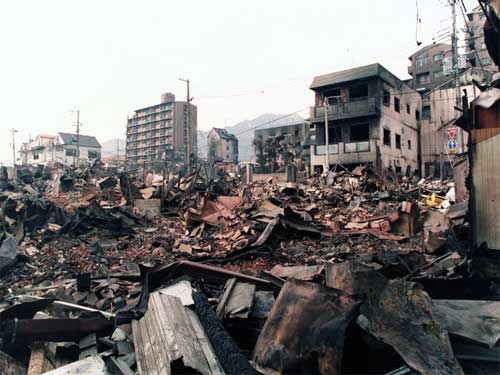
 

Earthquakes  


         Earthquakes are the shaking, rolling or sudden shock of the world’s surface. Earthquakes happen along ‘fault lines’ in the earth’s crust, and they can be felt over large areas although they usually last less than one minute. Earthquakes cannot be accurately predicted, although scientists are working on it. Most of the time, you will notice an earthquake by the gentle shaking of the ground. you may notice hanging plants swaying or objects wobbling on shelves. Sometimes you may hear a low rumbling noise or feel a sharp jolt. A survivor of the 1906 earthquake in San Francisco said the sensation was like riding a bicycle down a long flight of stairs.


         The intensity of an earthquake can be measured. One measurement is called the Richter scale. Earthquakes below 4.0 on this scale do not usually cause damage, but those over 5.0 on the scale do. A magnitude 6.0 is considered strong and magnitude 7.0 is a major earthquake. The most powerful earthquake ever felt occurred in Chile in 1960, near Valdivia, with a magnitude of 9.5, and the resulting tsunami reached Japan and the Philippines.
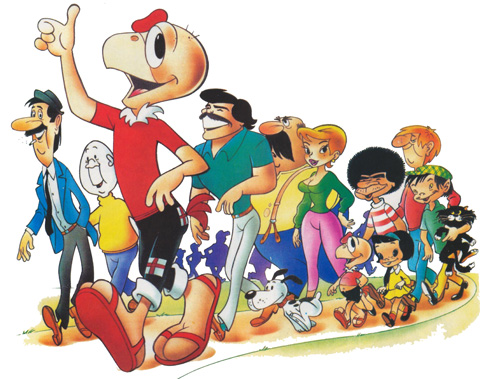
 

Condorito


         Condorito is a famous Chilean cartoon character, a personification of a funny condor living in a fictitious town named Pelotillehue, a setting typical of many small Chilean provincial towns. Contrary to popular belief, he is meant to be a representation of the Chilean people exclusively.


         Condorito was created by the Chilean cartoonist René Ríos, known as ‘Pepo’.  In spite of his Chilean origin, Condorito is very popular in several Latin American countries, in which the character is considered part of the general popular culture. Condorito and his friends are also featured monthly in a magazine that carries his name.


         One peculiar characteristic of this cartoon is that, at the end of almost every strip, the character that  goes through an embarrassing moment always falls backwards to the floor, accompanied by the PLOP! sound effect. Sometimes this effect is replaced by the victim saying, ‘ I demand an explanation!’


SNOOPY

Peanuts

Peanuts

Peanuts

Peanuts

Peanuts

BAKE NUT BISCUITS

You could make them with peanut butter too!

TIPS FOR PROTECTING THE ENVIRONMENT

Follow the link below to find lots of ideas which YOU can put into practice to protect our environment. It belongs to all of us, and we are all eventually responsible for what happens to our world. Future generations will thank you for every little effort we can make.

http://www.epa.gov/epahome/home.htm

Think about what we can do.

WATCH THIS VIDEO ABOUT OUR PAST AND OUR FUTURE

This video is  worth watching . Click on the following link:

http://www.youtube.com/watch?v=jqxENMKaeCU


FCE LINKS FOR INTERESTED STUDENTS

http://www.flo-joe.co.uk/fce/students/tests/tsindex.htm

http://www.englishspeaker.com/index%20-%20FCE.html#FCE

http://www.parapal-online.co.uk/

http://www.britishcouncil.org/croatia-exams-esol-resources.htm

Use these links to improve your FCE skills! 

DICTATIONS SECOND SENIORS (10,11,12)


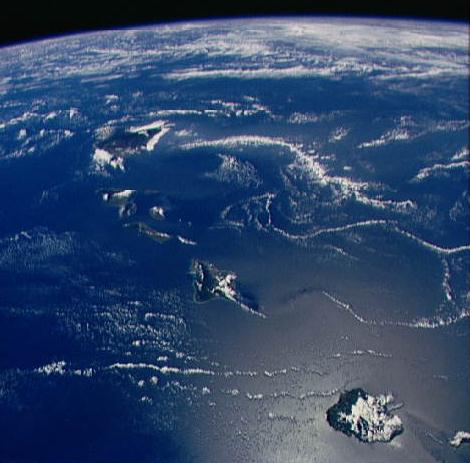
Hawaii, the Aloha State


This beautiful group of islands lying almost in the centre of the Pacific Ocean is more than just another holiday destination. It is not just  one place. It is a myriad of places with an enormous array of resorts and diversions and each island has something different to offer the visitor. The spirit of Aloha is everywhere. For many people, the mention of Hawaii brings Honolulu and Waikiki beach to mind, but all the islands are surrounded by beautiful palm-fringed beaches . The lush vegetation and scenic splendour of Kauai contrast sharply with the barren volcanic wilderness and fields of orchids on Hawaii, whilst Maui with its outdoor lifestyle and superb resorts is the opposite to the tranquil calm of underdeveloped Lanai or Molokai. Oahu, the main island, offers much more than the bright lights of Waikiki, which never sleeps.


The fresh floral air energises you, the warm, tranquil waters refresh you, and the breathtaking, natural beauty renews you. All this can happen in the six Hawaiian islands. Hawaii was first populated over 1,500 years ago by Polynesians from the Marquesas Islands, who arrived guided only by the stars.


Eco  Lodges


Once located exclusively in the African bush and Central American jungles, these retreats now span nearly every ecosystem and every budget-and their mission has never been more vital From Alaska to the Australian outback, these innovative retreats are committed to conservation  -  with the added value of cultural sensitivity, isolation, and, of course, style. Being green has never been so appealing.


            Designed to co-exist  in harmony with their surrounding environment, eco lodges utilize local businesses and labour. They are generally in remote locations but are still often luxurious and always comfortable. Most eco lodges celebrate and preserve native vegetation in their gardens and are usually good spots for watching wildlife. Staying at one permits you easy contact with local people and the opportunity to become familiar with their  way of life. In addition, you can take part in sponsored activities that have low impact on the environment. A true-eco lodge is basic, comfortable and  clean, with some of the usual conveniences and with simple but hearty meals of mainly local stuff to eat.


Wombats


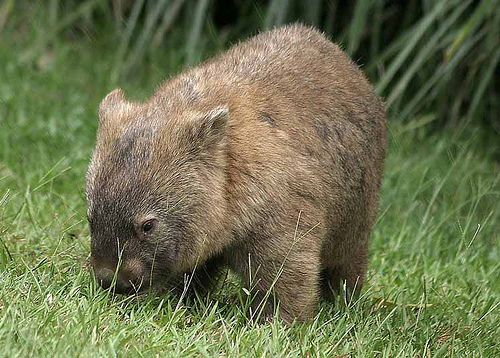
            Wombats are Australian marsupials, which are animals that carry their babies in a pocket, or pouch. They are short-legged, muscular quadrupeds, measuring about one metre in length, with a very short tail.  They can be found in forested and mountainous areas of south-eastern Australia and Tasmania. They prefer to come out in the evening and at night, so they are not normally seen around in the daytime. They live in burrows, which they dig throwing soil backwards. As it has a backward-facing pouch, it does not dirty its babies.


            Wombats are herbivores, eating grass, herbs and roots, and their metabolism is extraordinarily slow, taking up to two weeks to complete their digestion. One of their peculiar characteristics is their cube-shaped dung which they leave everywhere they transit. They move quite slowly, but can speed up to about 40 kph and keep up that speed for 90 seconds. Female wombats have one baby in spring, which remains in the pouch for about six to seven months. Their main enemies are dingos and Tasmanian Devils. When attacked, the wombat dives into the nearest tunnel, using its rump to block the attacker.


WHY IS IT IMPORTANT TO LEARN ENGLISH?

      The basic idea behind learning a language, any language, is to be able to communicate, to get an idea out of one person’s  brain into the brain of another. As many people all over the world speak English, English is one of the most effective languages for moving ideas around. If you include all those who speak English as a second language, English is the most spoken language on Earth. In the past, this was true for Latin and Greek.

       Wherever you go, English will be a requirement of some sort. It is used in tourism, business, education, literature, science,  show business, etc.  English could be considered as a passport to success in the world’s daily life. So, strive to be among the best.  Learn English!


INTERACTIVE FUN


Investigate these sites. I’m sure you’ll have a great time!

http://www.cut-the-knot.org/

http://www.clickmazes.com/

http://www.vtaide.com/png/puzzles.htm

http://www.jigzone.com/


SHORT STORIES


If you click on the below links, you’ll find several very interesting short stories to read and enjoy in your free time. You can read them online. If you prefer, look at the bar above, and choose fiction or nonfiction, poetry, plays(drama) or classical works of literature.

http://www.classicreader.com/browse/6/

http://www.eastoftheweb.com/short-stories/childrenindex.html

http://www.classicshorts.com/

http://www.americanliterature.com/ss/ssindx.html

http://www.britishcouncil.org/kids-stories-short.htm

http://www.englishclub.com/reading/short-stories.htm

Have fun!


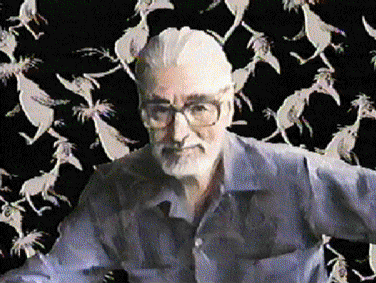
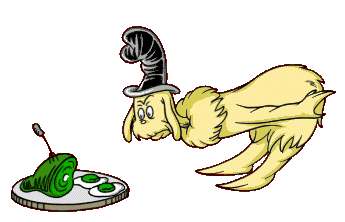
DR SEUSS

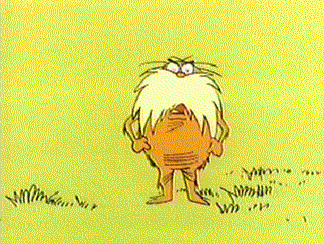
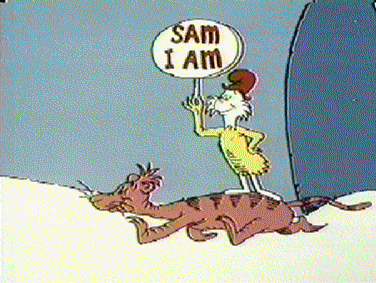
Remember The Cat in the Hat? The Grinch who stole Christmas? Horton Hatches the Egg? Green Eggs and Ham? And many more...

Click on the link, which will take you to the official Dr. Seuss site, and you can have fun looking around. The author, Theodore Seuss Geisel, known as Dr Seuss has given joy and happiness to many people all over the world.


http://www.seussville.com/


PUZZLES

Have fun and accept a challenge. Click on the National Geographic link below, which will take you directly to a choice of slide puzzles. Enjoy yourself. You have 590 puzzles to choose from.

http://ngm.nationalgeographic.com/your-shot/slide-puzzles


INTERNATIONAL YEAR OF ASTRONOMY

2009 has been declared International Year of Astronomy, and because of this, numerous events and activities have been planned world-wide. Below are some links which will take you to these and their dates, videos and other interesting information.


World-wide Information

http://www.astronomy2009.org/general/


Activities in Chile

http://www.astronomy2009.org/organisation/nodes/national/


Resources

http://www.astronomy2009.org/resources/

http://www.astronomy2009.org/resources/multimedia/videos/

This is is fascinating subject. Don’t pass up the opportunities offered!


OPTICAL ILLUSIONS

If you keep your eyes on the pink dots while they rotate, you will see only pink dots, whereas if you look at the black +  in the centre, they will turn to green. (this only happens to people who come from intelligent families)

Depending on how you look at the above picture, you will see ’optical’ or ’illusion’.

To stop the dots from moving, stare at one of them for a few moments, and the movement will stop.


RIDDLES

  1. What goes up and down stairs without moving?
  2. Give it food and it will live; give it water and it will die.
  3. What can you catch but not throw?
  4. I run, yet I have no legs. What am I?
  5. Take one out and scratch my head, I am now black but once was red.
  6. Remove the outside, cook the inside, eat the outside, throw away the inside.
  7. What goes around the world and stays in a corner?
  8. What gets wetter the more it dries?
  9. The more there is, the less you see.
  10. They come at night without being called and are lost in the day without being stolen.


Answers


1.   A carpet
2.   Fire
3.   A cold
4.   A nose
5.   A match
6.   Corn
7.   A stamp
8.   A towel
9.   Darkness
10. A towel

CHARLOTTE'S WEB

This is the scene from the original animated movie made in 1973 in which Wilbur meets Charlotte, a very special spider who will save him from becoming sausage meat.


DICTATIONS 7,8,9 (SECOND SENIORS)


The Swinging Sixties


            The sixties refers to the decade which started on January 1st, 1960, and ended on December 31st, 1969. The term also refers to an era more commonly called ‘The Sixties’, in which a social, political and economic upheaval took place in Europe , the USA and parts of Asia, especially Japan. It is called the swinging sixties because of the libertine attitudes and tendency to drug abuse that emerged at this time. especially among young people, like the hippie movement.


            In the 1960s, skirts got shorter, hair got longer, and for the first time in the  20th century,  pop music became a driving force in society.  This was especially true in Britain, home of The Beatles, whose songs provided a soundtrack to the era. England’s capital teemed with artists, models, pop stars, photographers, fashion designers, and hairdressers, all dedicated to the creation of new styles for the young. The fashions they set caught on all over the world, and also their message that life could be a party. The biggest sensation was caused by the outrageously short mini-skirt. It was made popular by hip models such as Twiggy. Pale lipstick and black eyeliner for girls were vital for the Sixties look.


 Marijuana


            Marijuana is a complex type of drug, which is obtained from the hemp plant, but unlike other well-known drugs, it is not recognised as a medicine. It is a psychoactive narcotic, extracted from the cannabis plant, which is either smoked or eaten, and has been used since ancient times. Known as marijuana in the Western Hemisphere, it is called kief in North Africa, charas in India and hashish in Egypt.


            Marijuana affects the central nervous system. Many people who are emotionally unstable can become marijuana users. It has different effects on different people, such as thirst, hunger, a craving for sweet foods, irritability, talkativeness, fear, depression, mental confusion and even delirium. Its use is forbidden by many countries all over the world, and can lead to stronger drug addiction. Some young people smoke it because of peer pressure or because they see others do it. Some of the short-term effects are memory and learning problems, distorted perception, trouble with thinking and problem-solving and loss of motor coordination. It affects judgement and decision-making, which could lead to risky sexual behaviour in teens, exposing them to sexually transmitted diseases, such as Aids.


  Cork


How many times have you opened a bottle of wine, sniffed the cork, and promptly thrown it out? Just what is that thing made of, and why is it used instead of rubber or screwcaps ?


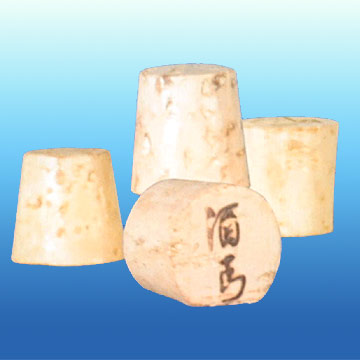
            Cork is the outer bark of the cork oak tree.  Two-thirds of the world’s cork supply comes from Spain and Portugal, where the cork oak is cultivated extensively. The older the cork tree, the more cork it produces. Some trees grow to be 170 years old. The purpose of using cork to seal bottles is to prevent oxygen from getting in.


            The cork oak grows from 6 to 12 metres tall, and can measure as much as one metre in diameter. The bark of this tree is usually first stripped when the tree is about 20 years old. This doesn’t injure or kill the tree; instead, the stripping actually benefits it. The bark is dried in strips for about 6 months, boiled for about 90 minutes, then dried again for three weeks. Finally, the cork is cut up into the shapes we are familiar with. About nine years later, another stripping is taken. The cork obtained from these two first strippings is coarse and tough. Later strippings, which are made about nine years apart for about a hundred years, give a cork of a finer quality.


ESU PUBLIC SPEAKING COMPETITION 2009

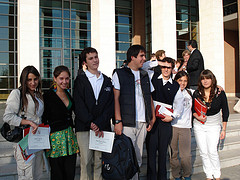
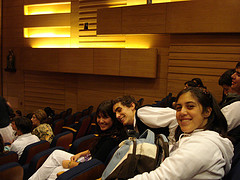
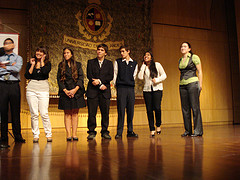
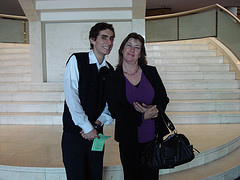
On April 15th St Paul’s sent a representative to Santiago to participate in the English Speaking Union Public Speaking Competition which took place at the Universidad de los Andes. Gabriel Orrego Romeu did a brilliant job, and came third among fifty-four participants from diverse schools from different parts of the country. His speech, ’Beyond the Scalpel’,was a mixture of humour and serious ideas, and was congratulated by several people, teachers and peer competitors. His teachers and school community feel very proud of his achievement.


   Viña schools attending

The teachers

  Gabriel and friends

  The eight finalists

Gabriel and his English teacher

Christine Evans


FIND OUT MORE ABOUT BRITAIN

Remember Winnie the Pooh? Well, here there is an opportunity which I have put on my blog in the past, and which I’m doing again because it is so good! Let Pooh Bear show you something of England, not only big cities but ways of life in rural areas, following the River Thames from its beginnings until it flows into the ocean. Click on the following link.


http://www.woodlands-junior.kent.sch.uk/riverthames/index.htm

If you want to find out more about British life and culture, click on the following link.


http://www.woodlands-junior.kent.sch.uk/customs/questions/

Have fun!


READING COMPREHENSION - IGUANA FARMING

Click on the following link to learn about a type of alternative farming and then do a comprehension exercise to see if you understood what it is about. Listen to the article as you read it.


http://www.britishcouncil.org/learnenglish-central-magazine-iguana-farming.htm

Good  luck !!!