ASKING FOR DIRECTIONS
How do you ask the way when you're new somewhere and don't know how to get there? Just listen and take note of the different ways of answering.

How do you ask the way when you're new somewhere and don't know how to get there? Just listen and take note of the different ways of answering.
I hope you enjoy this video as much as I did. I'm not really into animals, but this is a scream.
On January 24th,2007, students from our school were invited to a ceremony at The Mackay School, which commemorated its 150th anniversary. H.R.H. Princess Anne was invited as a very special visitor, and students from the Viña del Mar ABSCH schools had the opportunity of speaking to her in groups. She arrived promptly on time, as was to be expected. After speaking to members of the resident British community, she shared a few moments with firemen from the George Garland Fire Company, inspected the chapel, spoke to students of each of the British schools and finally planted a tree to commemorate the occasion of the anniversary. The students who attended were Daniel Ellwanger, Kay Wettergreen, Paula Ochsenius, Susana Viñuela, Angela Canessa, Claudia Alonso,Lorena Canessa, Pablo Mahana, Claudia Wesser, Francisca Woolvett, Francisca Jouanne and Francisca Acevedo. They attended cheerfully, even though it meant wearing a uniform in the middle of the holiday season! All in all, I believe it was a unique experience for all of them.
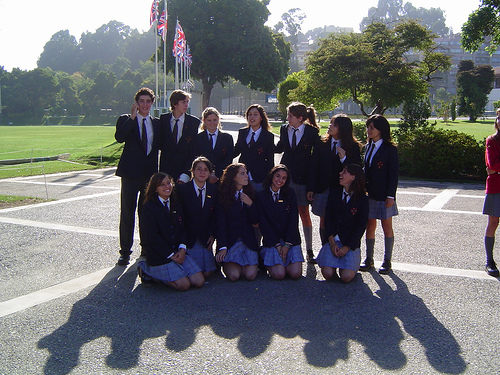
St. Paul's students attending The Mackay School on January 24th, 2007 during H.R.H. Princess Anne's visit.
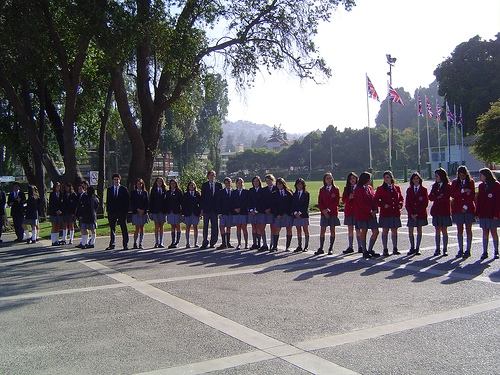
ABSCH students waiting for Princess Anne to arrive.
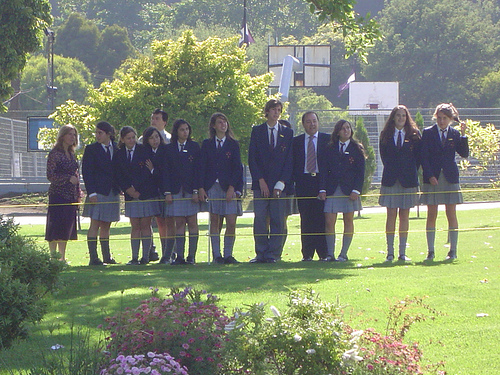
Awaiting the tree-planting ceremony.
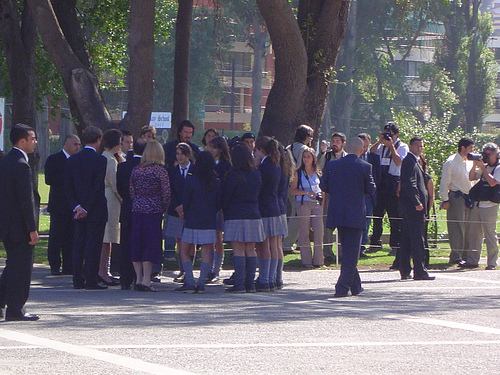
The princess speaking to St. Paul's students.
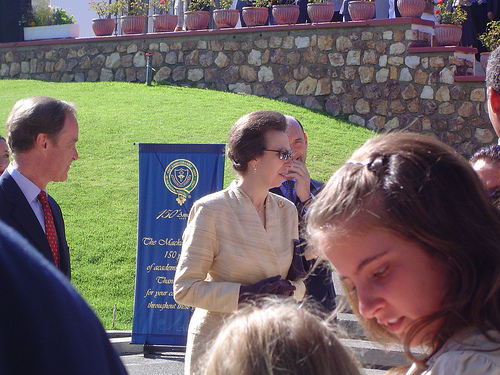
H.R.H. Princess Anne of England arriving at The Mackay School.
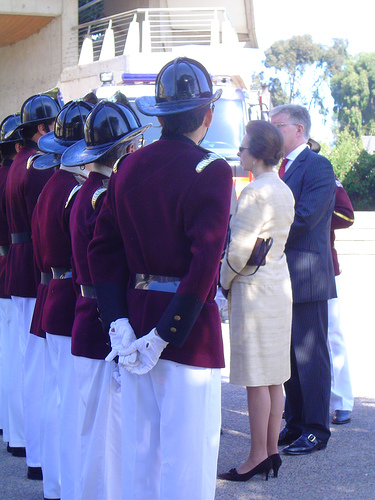
The princess speaking to the firemen of the George Garland Fire Company.

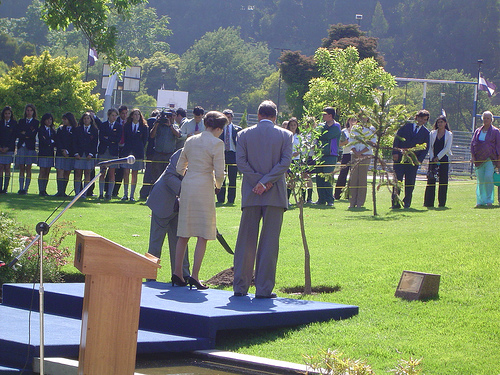
Princess Anne planting a tree to commemorate the anniversary.

Kay Wettergreen,Francisca Woolvett, Susana Viñuela, Paula Ochsenius.

Daniel Ellwanger, Margaret Gana, Nicolás Gana, Felipe Mahana

'Couple reading under a tree' Warren Dennis
Read! Read all you can. Read as much as you can. Read a variety of texts. Read books, articles, novels, newspapers, magazines, advertisements, brochures, leaflets, textbooks, text in films, tickets, etc. Even though you may not always understand everything you read, you will probably understand the general idea, and be able to deduce vocabulary and ideas. This will increase your comprehension, vocabulary and grammar. All this information will be stored in your passive knowledge area, and although you may not use the language or information immediately, one day you will find it becomes useful when the situation arises. So... read, read, read !
English Course - 2007
Important Considerations
Folder
The English folder must be up-to-date all the time. When you receive material, or work you have done (tests, writing, etc) is handed back to you, file it in the correct section immediately. This way, you’ll always have your material on hand (not folded in copybooks, textbooks, or anywhere else where it will most probably get lost!), and will be prepared for surprise/non-surprise folder checks all the time.
Folder Sections:
Materials
You should always have the following material with you in English class:
* pens, pencils, erasers, etc.
* copybook
* textbook and workbook
* folder
* dictionary, if necessary.
Attitude towards language learning
Your English teacher will speak to you in English ALWAYS. You should try to do the same. It is the only opportunity you have every day to practice your speaking skills, which will make the difference between you and others in your future, whatever you do after leaving school. English is all-important, and as I am sure you know, it becomes more important every day. Don’t be scared of making mistakes. This is normal and to be expected. The difference between successful language students and those who are not is that the successful ones learn from their mistakes and take a genuine interest in improving. This is what makes the difference. If you want to learn to swim, theory is useful, but to really be able to do it, you have to jump into the water at some moment. The same goes for language learning. If you want to communicate, you’ll have to speak. What better opportunity than to do it with someone who wants the best for you, and to give you all that is possible for your benefit in the future?
Take advantage of your teacher!
Do you want to participate in the international voting for the new seven wonders of the world? Now is your opportunity to become part of the global village. Click on the link below, and follow the instructions. A confirmation will be sent to your e-mail address with a link to vote for seven wonders for free. The next voting will take place in 2,000 years, so this is your only chance.

Vote for the Easter Island moais and help to make them one of the new seven wonders of the world!
http://www.new7wonders.com/index.php?id=351&L=0
In the following link, you will find the history of the Peanuts strip cartoon, from its creation by Charles M. Schulz, right up to the last cartoons made.
http://www.snoopy.com/comics/peanuts/history/timeline.html
I hope you enjoy it!
Patience and practice is important in the learning process for anything! Remember this when the going gets rough and you lose hope: PATIENCE and PRACTICE. So practise your patience skills.
We all want our world to last forever. So let's do what we can do as individuals, and by putting together all our efforts, help to keep it going, and to improve it, for ourselves and for those who will come after us.


Links to Peanuts video shorts
http://www.snoopy.com/comics/peanuts/fun_and_games/allstar.html
http://www.snoopy.com/comics/peanuts/fun_and_games/ragtime.html
http://www.snoopy.com/comics/peanuts/fun_and_games/realtor.html
http://www.snoopy.com/comics/peanuts/fun_and_games/amazing.html
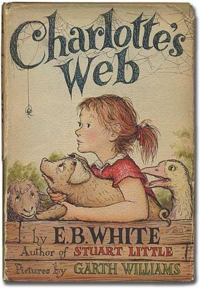
Charlotte's Web is a wonderfully touching story by E.B. White about friendship and loyalty which appeals to both young and old. He is also the creator of Stuart Little and The Trumpet of the Swan.You probably haven't read the story, but now is your opportunity to watch the 2006 film version, starring Julia Roberts, Oprah Winfrey, Dakota Fanning and John Cleese, among others. It features a spider, Charlotte, who becomes famous after she thinks of a way to save Fern's innocent young pig, Wilbur, from being slaughtered.
A link to the trailers and information about the film follows:
http://www.charlotteswebmovie.com/site/index.php
Next, you will find a link to a children's page which features more information and things to do after you have seen the film.
http://www2.lhric.org/pocantico/charlotte/index.htm
I'm sure you will really enjoy it!
An interview with Dakota Fanning and some inside information about one of the main characters.
 The 'Union Jack', or the flag
of the United Kingdom
Students can sometimes be confused by the terms Great Britain, England and the UK. The United Kingdom (UK) is composed by four countries: England, Scotland, Wales and Northern Ireland. The complete name is "The United Kingdom of Great Britain and Northern Ireland." England, Scotland and Wales make up Great Britain (GB , or just Britain). Northern Ireland and the Republic of Ireland make up the island of Ireland. The British Isles is another name for Great Britain and Ireland. Each of the four countries has its own flag, which, when superimposed, form what is known as the Union Jack.
Although the word 'dictation' may give you the shivers, it is very true that you learn a lot from them. They are useful because of the following:
* they help you improve your listening and writing skills
* they consolidate your spelling and punctuation
* they teach you new vocabulary
* they help you to learn about and understand different cultures and people

* they improve your general knowledge
* they teach you about intonation in another language
* they force you to write neatly and clearly
For these reasons and possibly more, you will find that dictations are useful. Some day you will realise how much you learned from them!
Pronunciation is important, as you will see in the following video.
Those hardworking pupils who put time and energy into preparing the FCE will realise that the effort was worth it when they apply for jobs after completing their studies at university level. A good FCE result shows you can deal confidently with a range of spoken and written communications, in everyday, business and study purposes, at an intermediate English ability.
Take a look at the advertisements published in many national newspapers and you will see how important knowledge of English is today, at all levels. If you want to study abroad, or develop a career which involves language skills, such as business, medicine or engineering, having passed the FCE means you are proficient enough in English to be able to use it in practical terms in clerical, secretarial or managerial jobs in many industries, particularly tourism, where contact with English speakers is required.
What does the exam involve?
FCE has five papers:Reading (Paper 1), 1 hour 15 minutes
This paper assesses your ability to read and understand texts taken from fiction and non-fiction books, journals, newspapers and magazines. You are expected to be able to show understanding of gist, detail and text structure, and deduce meaning.
Writing (Paper 2), 1 hour 30 minutes
This paper assesses your ability to write non-specialised text types such as letters, articles, reports, compositions and reviews of 120-180 words covering a range of topics and target readers and also set texts.
Use of English (Paper 3), 1 hour 15 minutes
This paper requires you to demonstrate your knowledge and control of the language system by completing various tasks at text and sentence level. These include filling gaps, transforming words and phrases, and identifying errors in texts.
Listening (Paper 4), 40 minutes (approx.)
This paper assesses your ability to understand the meaning of spoken English, and to extract gist and meaning from spoken text. The texts are taken from a variety of text types including interviews, discussions, lectures and conversations.
Speaking (Paper 5), 14 minutes
The Speaking Test assesses your ability to interact in conversational English in a range of contexts. It contains four parts, including an interview section, individual long turns of about one minute, a collaborative task and a discussion. You are provided with stimulus material such as photographs and drawings. You will normally take the Speaking Test in pairs.
As you can see, doing the FCE can only bring you benefits. So, what are you waiting for?
 Today, as the world’s resources are being used by a rapidly growing population, it is important to study the natural resources which have existed since time immemorial. There are several options: solar energy, wind power, water and geothermal energy. Solar energy is possible all over the world, and is already being used at the industrial and domestic level. Wind power is being used in some parts of the world, and has become an inexpensive solution in all of them. Hydroelectric plants take advantage of the power of running water and convert it to electricity. Areas which are on or near volcanic zones can take advantage of the thermal energy inside the earth for many purposes.
